Missing a tooth can affect much more than just your smile. It changes the way you eat, speak, and even how confident you feel in social situations. And when it comes to replacing missing teeth, two of the most common options people consider are dental implants and dental bridges.
But the real question most patients ask is:
Tooth implant or bridge — which is better?
The honest answer is: it depends on your oral health, budget, long-term goals, and the condition of surrounding teeth.
In this guide, let’s break everything down in a simple, practical, and human way so you can make the right decision without feeling overwhelmed.
First, Let’s Understand the Basics
What Are Dental Implants?
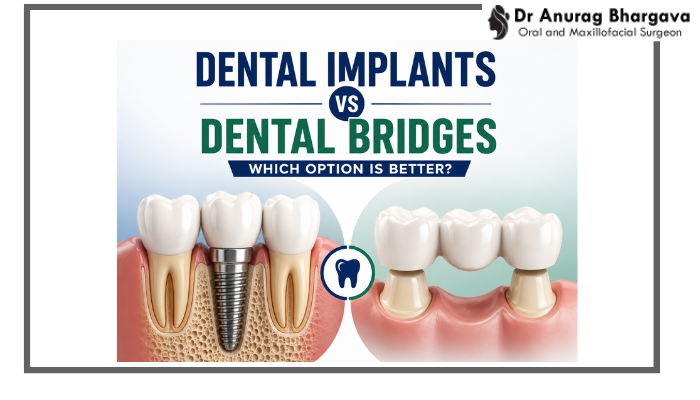
Dental implants are titanium posts placed inside the jawbone to act as artificial tooth roots. Once the implant heals and integrates with the bone, a crown is placed on top.
In simple terms:
Implant = artificial root + artificial tooth
Dental implants are considered one of the most advanced and long-lasting solutions for missing teeth.
What Is a Dental Bridge?
A dental bridge is a prosthetic tooth supported by the teeth next to the missing gap.
For example:
- If one tooth is missing, the nearby teeth are shaped down
- Crowns are placed on those teeth
- The false tooth sits in between like a “bridge”
This is why it’s called a single tooth bridge when replacing one missing tooth.
Dental Implants vs Dental Bridges: Quick Comparison Table
|
Feature |
Dental Implants |
Dental Bridge |
|
Longevity |
15–25 years or more |
5–15 years |
|
Bone Preservation |
Prevents bone loss |
Does not preserve bone |
|
Procedure |
Surgical |
Non-surgical |
|
Effect on Nearby Teeth |
No damage |
Adjacent teeth trimmed |
|
Stability |
Feels like natural tooth |
Good but less stable |
|
Cleaning |
Similar to natural teeth |
Requires special flossing |
|
Cost |
Higher upfront |
More affordable initially |
|
Maintenance |
Low |
Moderate |
|
Best For |
Long-term replacement |
Faster tooth replacement |
|
Appearance |
Highly natural |
Natural-looking |
1. Longevity: Which Lasts Longer?
This is one of the biggest deciding factors.
Dental Implants
With proper care, dental implants can last:
- 15–25 years
- Sometimes even lifetime
Because they fuse with the jawbone, they are extremely durable.
Dental Bridge
A dental bridge generally lasts:
- 5–15 years
Over time, the supporting teeth may weaken or develop issues.
Winner: Dental implants
2. Impact on Natural Teeth
This is where implants have a major advantage.
Dental Bridge
To place a bridge, healthy nearby teeth are shaved down to support the prosthetic.
That means:
- Healthy tooth structure is removed permanently
Dental Implants
Implants are independent and don’t affect surrounding teeth.
Winner: Dental implants
3. Bone Health & Facial Structure
Here’s something many people don’t realize:
When a tooth is missing, the jawbone underneath starts shrinking.
Dental Implants
Since implants act like real roots, they stimulate the jawbone and prevent bone loss.
Dental Bridge
Bridges replace only the visible tooth — not the root. Bone shrinkage may continue underneath.
Winner: Dental implants
4. Procedure & Treatment Time
Now let’s talk about the actual process.
Dental Bridge
The process is faster:
- Usually completed within 1–2 weeks
- No surgery required
Dental Implants
Implants take longer because:
- Surgery is involved
- Healing takes 3–6 months
Winner for speed: Dental bridge
If you want a quick solution, bridges are often preferred.
5. Comfort & Natural Feel
Most patients want replacement teeth to feel normal.
Dental Implants
They feel very close to natural teeth because they are fixed inside the bone.
Dental Bridge
Bridges also feel comfortable, but some patients notice pressure on neighboring teeth.
Winner: Dental implants
6. Appearance & Smile Aesthetics
Both options look natural when done properly.
However:
- Implants provide better gum contour over time
- Bridges may show gum changes after years
Modern crown and bridge teeth technology has improved aesthetics significantly, but implants still tend to give a more natural long-term appearance.
👉 Slight edge: Dental implants
7. Cost Comparison
Let’s be honest — budget matters.
Dental Implants
Higher upfront investment because:
- Surgery
- Implant material
- Multiple appointments
Dental Bridge
Usually more affordable initially.
However, bridges may require replacement earlier.
👉 Short-term affordability: Dental bridge
👉 Long-term value: Dental implants
8. Maintenance & Cleaning
Dental Implants
Care is similar to natural teeth:
- Brushing
- Flossing
- Regular check-ups
Dental Bridge
Requires extra care underneath the bridge using special floss or tools.
👉 Easier maintenance: Dental implants
Single Tooth Bridge vs Implant: Which Is Better?
If you’re missing just one tooth, this is a common comparison.
Single Tooth Bridge
Good if:
- Nearby teeth already need crowns
- You want faster treatment
- You prefer lower upfront cost
Implant
Better if:
- Adjacent teeth are healthy
- You want long-term durability
- Bone preservation matters
In most cases, dentists today recommend implants for single tooth replacement whenever possible.
Who Should Choose Dental Implants?
You may be a good candidate if:
- You have healthy gums
- Adequate jawbone is present
- You want a permanent solution
- You don’t mind longer treatment time
Who Should Choose a Dental Bridge?
A bridge may suit you if:
- You want faster replacement
- Surgery isn’t preferred
- Nearby teeth already require crowns
- Budget is limited
Are Dental Implants Painful?
This is probably the most searched concern.
The truth:
👉 Implant procedures are done under anesthesia.
Most patients experience:
- Mild soreness
- Minimal discomfort
In fact, many say it’s easier than tooth extraction.
Common Mistakes People Make
❌ Choosing only based on cost
❌ Ignoring bone health
❌ Delaying missing tooth replacement
❌ Not consulting an experienced dentist
Missing teeth should not be ignored for too long because surrounding teeth shift over time.
Final Thoughts
So, Dental Implants vs Dental Bridges – Which Option Is Better?
👉 If you want:
- Long-term durability
- Bone preservation
- Natural feel
Then dental implants are usually the better choice.
👉 If you want:
- Faster treatment
- Lower upfront cost
- Non-surgical option
Then a dental bridge may work well.
The best solution depends on your oral condition, lifestyle, and expectations.
Frequently Asked Questions (FAQs)
1. Which is better: bridge or implant?
Dental implants are usually better for long-term durability and bone preservation, while bridges are faster and more affordable initially.
2. Are dental implants painful?
No, dental implants are placed under anesthesia. Most patients experience mild discomfort afterward, which is manageable with medication.
3. How long does a dental bridge last?
A dental bridge generally lasts between 5–15 years, depending on oral hygiene and the condition of supporting teeth.
4. How long do dental implants last?
Dental implants can last 15–25 years or even longer with proper care and regular dental check-ups.
5. What is a single tooth bridge?
A single tooth bridge replaces one missing tooth using neighboring teeth as support for the artificial tooth.
6. Can a bridge damage nearby teeth?
Yes, a dental bridge requires nearby healthy teeth to be reshaped, which permanently alters them.
7. Are implants better than crown and bridge teeth?
In many cases, yes. Implants preserve bone and don’t affect nearby teeth, unlike traditional crown and bridge teeth treatments.
8. Which option looks more natural?
Both look natural, but dental implants generally provide better long-term aesthetics and gum contour.
9. What is cheaper: implant or bridge?
Dental bridges are usually cheaper initially, but implants may offer better long-term value due to durability.
10. Can everyone get dental implants?
Not always. Adequate bone density and healthy gums are important. A dental consultation determines eligibility.
Ready to Restore Your Smile?
If you’re confused between a dental bridge and dental implants, expert guidance can help you choose the right solution based on your oral health and long-term goals.
Book your consultation with Dr. Anurag Bhargava and take the first step toward a healthier, confident smile.
About the Author
Dr. Anurag Bhargava is a qualified cosmetic and reconstructive surgeon specializing in facial deformity correction, rhinoplasty, jaw surgery, cleft lip and palate repair, and post-traumatic facial reconstruction. Dr. Bhargava is committed to delivering safe, evidence-based, and natural-looking results for patients of all ages.
BDS, MDS (Oral & Maxillofacial Surgery), FICOI (USA), Diplomate – WCOI (Japan)