
Welcoming a newborn into the world is one of the most emotional and beautiful experiences for parents. But sometimes, during those first few hours or days after birth, parents may notice something unexpected — a difference in their baby’s lip, mouth, or feeding pattern.
One condition that often raises questions and concerns is cleft lip and palate.
If you are reading this because you suspect something unusual or simply want to understand the early signs better, you’re in the right place.
The good news is this:
Early diagnosis and timely treatment can make a huge difference.
Let’s talk about the early signs of cleft lip, what parents should watch for, and when to seek medical help.
What Is Cleft Lip and Palate?
Before discussing signs, let’s understand the basics.
A cleft lip occurs when the upper lip does not completely join during pregnancy.
A cleft palate occurs when the roof of the mouth does not fully close.
Some babies may have:
- Only cleft lip
- Only cleft palate
- Both cleft lip and palate
The condition can vary from mild to severe.
Some babies have a tiny notch in the lip.
Others may have a complete opening affecting both sides of the lip and palate.
Why Does Cleft Lip and Palate Happen?
Parents often ask:
“Did we do something wrong?”
The answer is usually no.
The exact cleft lip causes are not always clear.
However, several factors may contribute:
- Genetic factors
- Family history
- Nutritional deficiencies during pregnancy
- Environmental influences
- Certain medications during pregnancy
Most importantly:
Parents should not blame themselves.
Early Signs of Cleft Lip in Newborns
Some signs are immediately visible after birth.
Others become noticeable during feeding.
Let’s discuss the most common ones.
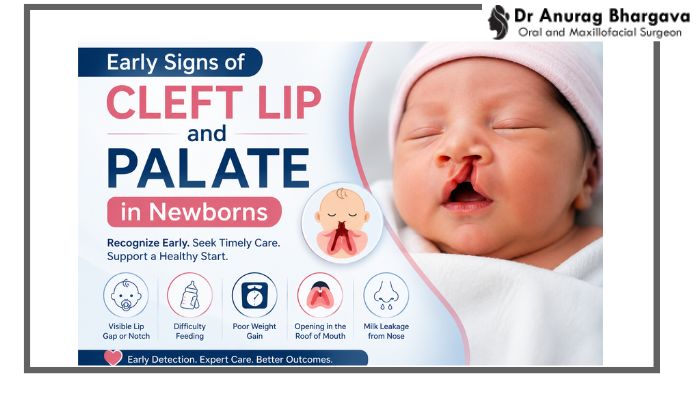
1. Visible Gap or Opening in the Upper Lip
This is usually the easiest sign to recognize.
You may notice:
- Small notch in the upper lip
- Split extending toward the nose
- Separation affecting one or both sides
Sometimes the opening is small.
Sometimes it is larger.
This visible opening is one of the earliest signs of cleft lip.
2. Difficulty Feeding
Many newborns with cleft lip and palate struggle with feeding.
Parents may notice:
- Milk leaking from the nose
- Poor suction
- Difficulty latching during breastfeeding
- Long feeding times
Feeding problems often become one of the first concerns parents notice.
3. Clicking Sounds During Feeding
Babies with palate involvement may struggle to create proper suction.
This sometimes causes:
- Clicking noises while feeding
- Frequent breaks during feeding
- Frustration while eating
These signs may indicate a hidden palate issue.
4. Poor Weight Gain
Because feeding becomes difficult, some babies may:
- Feed less efficiently
- Consume less milk
- Gain weight slowly
Slow weight gain does not always mean cleft conditions, but it should never be ignored.
5. Opening Inside the Mouth
Sometimes parents do not immediately notice palate involvement.
Look inside the baby’s mouth carefully.
You may notice:
- Visible gap in the roof of the mouth
- Separation inside the palate
- Opening extending toward the back
Some cases of incomplete cleft lip may appear subtle externally but involve internal structures.
6. Changes in Nose Shape
Some babies with bilateral cleft lip may have:
- Wider nose appearance
- Flattened nasal tip
- Uneven nostrils
These changes occur because facial structures develop together during pregnancy.
7. Bilateral Cleft Lip and Palate Signs
Bilateral cleft lip and palate means both sides of the lip are affected.
Parents may notice:
- Opening on both sides of the lip
- Center portion of lip appearing separated
- More visible facial changes
Because both sides are involved, this form is often easier to identify immediately.
8. Frequent Choking or Coughing During Feeding
Because milk flow becomes difficult to control, babies may:
- Cough frequently
- Choke during feeding
- Become tired while eating
These feeding challenges are common signs that deserve evaluation.
What Does Incomplete Cleft Lip Look Like?
Some parents expect cleft conditions to always be obvious.
That is not always true.
Incomplete cleft lip may appear as:
- Tiny notch in the lip
- Small separation without reaching the nose
- Mild asymmetry
Because these cases are subtle, they may sometimes be missed initially.
Can Cleft Lip Be Detected Before Birth?
Sometimes yes.
Modern ultrasound scans may identify:
- Bilateral cleft lip
- Larger facial openings
- Significant facial differences
However:
Some palate defects remain difficult to detect during pregnancy.
This is why newborn examination remains important.
What Should Parents Do If They Notice These Signs?
First:
Do not panic.
The next steps are simple:
Consult a Specialist
Early evaluation helps create a treatment plan.
Focus on Feeding Support
Special feeding techniques may help.
Follow Recommended Treatment Timing
Early intervention improves outcomes.
When Is Treatment Usually Done?
Treatment depends on the condition.
General timing:
Lip Repair
Usually around:
3–6 months
Palate Repair
Usually around:
9–18 months
Additional treatments may continue as the child grows.
Emotional Side: What Parents Need to Know
Receiving this diagnosis can feel overwhelming.
Parents commonly experience:
- Anxiety
- Fear
- Guilt
- Confusion
These feelings are normal.
Remember:
Children with cleft lip and palate grow up healthy, active, confident lives when treated properly.
You are not alone.
Can Babies With Cleft Lip Live Normal Lives?
Absolutely.
With proper care:
- Feeding improves
- Speech develops normally
- Facial growth improves
- Confidence increases
Modern treatment has transformed outcomes dramatically.
Final Thoughts
The earlier you recognize signs of cleft lip and palate, the earlier treatment and support can begin.
Watch for:
✓ Feeding problems
✓ Visible lip differences
✓ Milk leakage
✓ Weight concerns
✓ Changes inside the mouth
Most importantly:
Early recognition creates better outcomes.
If you notice anything unusual, professional evaluation is always the safest next step.
Frequently Asked Questions (FAQs)
1. What are the first signs of cleft lip in newborns?
Visible lip opening, feeding difficulty, milk leakage, and poor suction are among the earliest signs.
2. Can cleft palate be missed at birth?
Yes. Some palate defects may be less visible and become noticeable only during feeding difficulties.
3. What causes cleft lip and palate?
Common cleft lip causes include genetics, family history, environmental factors, and developmental changes during pregnancy.
4. What is bilateral cleft lip?
Bilateral cleft lip means the split affects both sides of the upper lip rather than one side.
5. What is bilateral cleft lip and palate?
Bilateral cleft lip and palate affects both sides of the lip along with the roof of the mouth.
6. What does incomplete cleft lip mean?
Incomplete cleft lip means the lip separation does not extend completely toward the nose.
7. Can babies with cleft lip breastfeed?
Some babies can breastfeed successfully, while others may need feeding support or specialized techniques.
8. When is cleft lip surgery usually done?
Lip repair is commonly performed between 3–6 months depending on the child’s condition.
9. Is cleft lip dangerous?
Cleft conditions themselves are not usually dangerous but may affect feeding, speech, and development if untreated.
10. Can cleft lip and palate be completely treated?
Most children achieve excellent functional and cosmetic outcomes with proper treatment and long-term care.
About the Author
Dr. Anurag Bhargava is a qualified cosmetic and reconstructive surgeon specializing in facial deformity correction, rhinoplasty, jaw surgery, cleft lip and palate repair, and post-traumatic facial reconstruction. Dr. Bhargava is committed to delivering safe, evidence-based, and natural-looking results for patients of all ages.
BDS, MDS (Oral & Maxillofacial Surgery), FICOI (USA), Diplomate – WCOI (Japan)
