
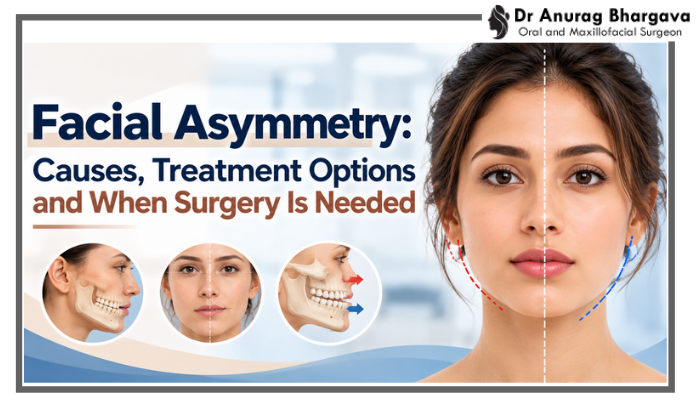
Have you ever looked in the mirror and noticed that one side of your face looks slightly different from the other? Perhaps one cheek appears fuller, one eyebrow sits a little higher, or your jaw seems to shift slightly to one side when you smile. If so, you are not alone.
Facial asymmetry is more common than most people realise. Almost nobody has a perfectly symmetrical face. Small differences between the two sides are a normal part of human appearance, and they usually do not require any treatment.
However, sometimes the difference is more noticeable. It may affect the shape of the jaw, the position of the chin, the alignment of the teeth, or the overall balance of the face. In some cases, it can also be associated with difficulty chewing, jaw discomfort, or problems with the way the teeth fit together.
So, how do you know whether facial asymmetry is simply a natural feature or something that needs medical attention? And if treatment is necessary, does it always mean surgery?
Let's explore the causes of facial asymmetry, the available treatment options, and the situations in which surgery may be considered.
What Is Facial Asymmetry?
Facial asymmetry refers to a difference in the size, shape, position, or appearance of the two sides of the face.
For example, the left side of your jaw might look slightly different from the right, or your chin may appear a little off-centre. One side of your face may also look fuller because of differences in the underlying bones, muscles, or soft tissues.
These differences can be present from birth or develop gradually as you grow older. They may also occur following an injury, certain medical conditions, or changes in the jaw and facial structures.
It is important to understand that facial asymmetry does not automatically mean something is wrong. A small amount of asymmetry is normal. Treatment is usually considered when the difference causes functional problems, is linked to an underlying condition, or is a concern that someone wishes to discuss with a qualified specialist.
The right approach depends on what is causing the asymmetry, how pronounced it is, and whether it affects facial function as well as appearance.
What Causes Facial Asymmetry?
There is no single reason why a face may look uneven. In some people, it is simply how their facial features developed. In others, the difference may be related to the jawbones, teeth, facial muscles, soft tissues, or a previous injury.
Understanding the cause is the first step towards choosing the right treatment.
1. Genetics and Natural Facial Development
Take a look at your family members, and you may notice that certain facial features run in the family. The shape of the nose, cheekbones, chin, and jaw can all be influenced by genetics.
Facial bones and soft tissues also do not always develop at exactly the same rate on both sides. This can leave one side slightly different from the other.
If your facial asymmetry has been present for as long as you can remember and has not changed significantly, it may simply be a natural variation.
2. Uneven Jaw Growth
The jaw plays a major role in how balanced your face looks. If one side of the upper or lower jaw grows differently from the other, the chin may appear off-centre and the jawline may look uneven.
For example, one side of the lower jaw may be longer or more developed, causing the chin to shift towards one side. In other cases, one part of the jaw may not develop fully.
These differences can affect more than appearance. Depending on their severity, they may also cause an uneven bite, difficulty chewing, or problems with the alignment of the teeth.
When the asymmetry is caused by the underlying jawbones, a dental or orthodontic assessment alone may not be enough to determine the complete treatment plan. A specialist may need to assess the facial skeleton as well.
3. Misaligned Teeth and Bite Problems
Have you noticed that your chin moves to one side when you close your mouth? Or perhaps your upper and lower teeth do not meet evenly.
Sometimes, the appearance of an asymmetrical face is related to the way the teeth fit together.
Crowded teeth, a misaligned bite, or differences in the position of the dental arches can influence how the jaw closes. In some people, the lower jaw shifts to one side when biting, making the face appear uneven.
This is why it is important to look beyond the mirror when investigating facial asymmetry. A specialist may need to assess your bite, dental midline, and jaw movement to understand what is happening.
If the main problem is dental, orthodontic treatment may be helpful. If the underlying jawbones are also misaligned, additional treatment may be necessary.
4. Facial Injuries or Accidents
An accident, fall, sports injury, or other facial trauma can change the shape and balance of the face.
For example, a fracture involving the cheekbone or jaw may heal in a position that affects facial symmetry. Damage to the soft tissues can also leave one side looking different from the other.
Some differences become noticeable immediately after an injury, while others may remain after the initial swelling has gone down.
If you notice persistent unevenness after facial trauma, an evaluation can help determine whether the problem involves the bone, muscles, or soft tissues. The treatment will depend on the type and extent of the injury.
5. Congenital Conditions
Some people are born with conditions that affect the development of the face.
Cleft lip and palate, hemifacial microsomia, and certain craniofacial conditions can influence the growth or formation of facial structures. Depending on the condition, one side of the face may develop differently from the other.
The extent of the asymmetry varies considerably. Some people have relatively subtle differences, while others may have more noticeable changes involving the jaw, cheek, ear, or surrounding tissues.
Treatment may involve more than one specialist, particularly when facial development, dental alignment, and function are all affected. The treatment plan is based on the individual's needs rather than a single standard procedure.
6. Changes in the Jaw Joint
The temporomandibular joint, commonly called the TMJ, connects your lower jaw to your skull. It helps you open and close your mouth, speak, and chew.
Problems affecting this joint can sometimes contribute to changes in jaw movement or facial symmetry. In certain cases, joint inflammation, damage, restricted movement, or differences in joint growth may affect how the jaw sits.
You might also notice jaw discomfort, clicking, restricted mouth opening, or a change in your bite. These symptoms do not automatically mean that the TMJ is causing your facial asymmetry, but they are worth discussing with a specialist.
A proper examination helps determine whether the joint, the jawbone, the teeth, or another structure is responsible.
7. Facial Muscle or Nerve Problems
Not every asymmetrical face is caused by uneven bones.
The facial muscles control movements such as smiling, raising your eyebrows, and closing your eyes. If one side of the face has reduced muscle movement or weakness, your expression may appear uneven even when the underlying bone structure is not the main issue.
Conditions affecting the facial nerve, including Bell's palsy, can cause one-sided facial weakness. Other neurological conditions can also affect facial movement.
This distinction matters because jaw surgery will not address every cause of facial asymmetry. If the problem is related to nerve or muscle function, the appropriate assessment and treatment may be entirely different.
Important: If one side of your face suddenly droops or becomes weak, especially alongside difficulty speaking, arm weakness, or confusion, seek emergency medical attention immediately. Sudden facial drooping can be a sign of a stroke. Do not assume that it is simply a cosmetic concern.
8. Ageing and Changes in Soft Tissues
Facial appearance can change as you grow older. Skin elasticity decreases, facial fat distribution changes, and the underlying bones and muscles can also change over time.
These changes may make differences between the two sides more noticeable. One cheek might appear less full, or one side of the lower face may look more sagging than the other.
In such cases, the concern may be related more to soft-tissue volume or skin changes than to the position of the jawbones.
That is why the treatment for age-related facial asymmetry may differ from the treatment for an uneven jaw or a skeletal deformity.
How Can You Tell If Your Facial Asymmetry Needs Treatment?
Not every uneven feature needs correcting. The more important question is whether the difference is new, changing, affecting your daily activities, or causing you concern.
You may want to arrange an assessment if you notice:
- Your chin or jaw appears increasingly off-centre.
- Your upper and lower teeth do not meet properly.
- You find chewing difficult or uncomfortable.
- Your jaw movement feels restricted or uneven.
- Your face has become noticeably different after an accident.
- One side of your face has reduced movement.
- An existing facial difference is becoming more pronounced.
These signs do not necessarily mean that you need surgery. They simply suggest that understanding the underlying cause may be worthwhile.
A long-standing, mild difference without other symptoms is often a normal variation. A new or progressive change, however, deserves medical evaluation.
How Is Facial Asymmetry Diagnosed?
Before deciding how to treat facial asymmetry, a specialist needs to understand what is causing it. Two people may have similar-looking uneven jawlines but require completely different approaches.
Your assessment may involve several steps.
Medical History and Facial Examination
The specialist may ask when you first noticed the difference, whether it has changed over time, and whether you have experienced any injuries or jaw-related symptoms.
They will examine your face from different angles and assess the position of your chin, jawline, cheeks, and other facial features. Your bite, tooth alignment, and jaw movements may also be checked.
Photographs and Imaging
Photographs can help document facial proportions and compare the two sides of your face. Depending on the suspected cause, the specialist may recommend X-rays, dental imaging, or a three-dimensional scan.
These investigations can help identify whether the asymmetry involves the facial bones, teeth, or soft tissues and assist with treatment planning. Not everyone needs every type of scan; the choice depends on the individual assessment.
What Are the Treatment Options for Facial Asymmetry?
There is no single treatment that works for every type of facial asymmetry. The right option depends on whether the difference comes from the teeth, jawbones, facial muscles, or soft tissues.
Here are some of the approaches a specialist may consider.
1. Orthodontic Treatment
If the main concern is related to tooth alignment or the way your upper and lower teeth meet, orthodontic treatment may be appropriate.
Braces or other orthodontic appliances can help reposition the teeth and improve the bite. In selected cases, correcting the dental alignment may also improve the appearance of the smile and the way the jaw closes.
However, braces cannot independently correct every significant difference in the size or position of the jawbones. If the asymmetry is primarily skeletal, your orthodontist may recommend an assessment by an oral and maxillofacial surgeon.
2. Dermal Fillers or Fat Grafting
Sometimes, the bones are reasonably well aligned, but one cheek looks fuller than the other because of differences in soft-tissue volume.
In selected cases, dermal fillers or fat grafting may help improve facial balance by adding volume to an area that appears less full.
Fat grafting involves transferring a person's own fat to another area of the face. Whether either option is appropriate depends on the cause of the asymmetry, the amount of correction required, and individual medical considerations.
These treatments do not reposition the jawbones or correct an underlying skeletal deformity. They are primarily considered for selected soft-tissue or contour concerns.
3. Chin Correction Surgery
The chin has a noticeable influence on the overall balance of the lower face.
If the chin sits off-centre or has a shape that contributes to facial asymmetry, a surgeon may consider chin correction. Depending on the underlying problem, this could involve reshaping or repositioning the chin bone, or using an implant in selected cases.
However, chin surgery alone may not be enough if the asymmetry originates higher up in the upper or lower jaw. A detailed assessment helps determine whether the chin is the main issue or whether the wider jaw structure needs attention.
4. Facial Implants or Bone Grafting
When one part of the face is underdeveloped or lacks volume, a facial implant or bone graft may be considered in selected cases.
For example, an implant may be used to improve the contour of the cheek or jawline when the underlying structure on one side is smaller than the other.
Bone grafting may be considered when additional structural support or volume is required.
These are not universal solutions. The surgeon must assess how the underlying bone and overlying soft tissues interact, because correcting one layer does not always make every visible difference disappear.
5. Facial Reanimation or Muscle-Related Treatment
When facial asymmetry is associated with weakness or reduced movement on one side, treatment needs to address the cause of that movement problem.
Depending on the diagnosis, care may involve treatment for the underlying condition, facial rehabilitation, selected injections, or reconstructive procedures designed to improve facial movement.
These approaches are different from surgery that reshapes the jaw. The priority is to identify the affected nerve or muscle function and determine which treatment is appropriate.
When Is Surgery Needed for Facial Asymmetry?
This is one of the biggest questions people have when considering treatment.
Facial asymmetry surgery may be considered when a significant difference in the facial bones or jaw structure cannot be adequately addressed with non-surgical treatment alone.
For example, surgery may be discussed when:
- The upper or lower jaw has developed unevenly.
- The chin is significantly displaced because of jawbone asymmetry.
- A skeletal difference contributes to a poor bite.
- An injury has caused a lasting change in facial bone position.
- A congenital condition has affected facial development.
- The asymmetry affects both facial appearance and function.
The decision is not based only on how uneven the face looks. The specialist also considers the cause, severity, jaw function, age, facial growth, overall health, and the results that can realistically be achieved.
Some people may benefit from orthodontic or soft-tissue treatment. Others may need surgery to correct the underlying bone structure. In certain complex cases, a combination of treatments may be recommended.
What Is Orthognathic Surgery, and How Can It Help?
Orthognathic surgery, also called corrective jaw surgery, is used to reposition the upper jaw, lower jaw, or both when their alignment is significantly abnormal.
Imagine that your lower jaw has grown more on one side than the other. As a result, your chin may sit off-centre, and your teeth may not meet evenly. If the underlying problem involves the jawbones, simply straightening the teeth may not correct the overall imbalance.
In suitable cases, orthognathic surgery allows the surgeon to reposition the jawbones to improve their alignment and relationship with the teeth.
Depending on the individual's condition, treatment may help improve:
- Jaw and bite alignment
- The position of the chin
- Overall facial proportions
- Chewing function
- The relationship between the upper and lower teeth
Orthognathic surgery is often planned alongside orthodontic treatment. Braces may be used before surgery to prepare the teeth and afterward to refine their alignment.
The treatment plan is highly individual. The aim is to improve function and facial balance while accounting for the patient's specific anatomy and expectations.
What Happens During Facial Asymmetry Surgery?
The procedure depends on which part of the face needs correction. There is no single operation for all cases.
Generally, the process begins with a detailed consultation and assessment. The surgeon reviews your facial proportions, bite, medical history, and imaging results before discussing the possible surgical approach.
If the asymmetry is caused by the jawbones, the operation may involve repositioning or reshaping one or both jaws. In other cases, the procedure may focus on the chin, cheekbones, or selected soft tissues.
The surgeon will explain the planned changes, expected recovery, potential risks, and any additional treatment that may be required.
Because facial bones and soft tissues heal at different rates, the final appearance may take time to settle. Swelling can temporarily affect facial contours, so early postoperative appearance should not be treated as the final result.
What Is Recovery Like After Facial Asymmetry Surgery?
Recovery varies depending on the procedure performed. A smaller contour procedure and a major jaw operation have different recovery requirements.
After surgery, some swelling, bruising, discomfort, and temporary changes in sensation may occur. Jaw surgery may also involve changes to eating, oral hygiene, and daily activities while the tissues heal.
Your surgeon will explain how to manage your recovery, when to attend follow-up appointments, and when you can gradually return to your normal routine.
It is also important to understand that facial asymmetry correction does not guarantee perfect symmetry. Even after the underlying bones are repositioned, differences in the soft tissues may remain.
A realistic treatment goal is an appropriate improvement in facial balance and function, rather than absolute mirror-image symmetry.
Can Facial Asymmetry Be Corrected Without Surgery?
Yes, some forms of facial asymmetry can be improved without surgery, but it depends on the cause.
If the difference is related to tooth alignment, orthodontic treatment may help. If it is mainly related to selected soft-tissue volume differences, fillers or fat grafting may be considered.
However, when the underlying problem is a significant difference in the size or position of the jawbones, non-surgical treatments may not provide the same structural correction.
Be cautious about online exercises, facial massage routines, or products claiming to permanently straighten an uneven jaw. They should not be relied upon to correct a significant skeletal difference.
The most useful first step is to establish what is causing the asymmetry. Once the cause is clear, a specialist can explain whether non-surgical treatment is reasonable or whether surgery is worth considering.
Final Thoughts
Facial asymmetry can be as subtle as a slightly uneven smile or as noticeable as a chin that sits significantly off-centre. In many people, it is simply a natural feature. In others, it may be related to jaw growth, dental alignment, facial injury, or differences in the soft tissues.
The important thing is not to assume that every uneven feature needs surgery—or that every case can be corrected without it.
If you have concerns about facial asymmetry, a proper assessment can help identify the cause and explain which options are suitable for you. For some people, no treatment is necessary. For others, orthodontic treatment, soft-tissue procedures, chin correction, or orthognathic surgery may be considered.
If the asymmetry involves the jawbones or affects your bite, consulting an experienced oral and maxillofacial surgeon can help you understand the available options and make an informed decision.
Frequently Asked Questions About Facial Asymmetry
1. What causes facial asymmetry?
Facial asymmetry can result from genetics, uneven jaw growth, dental misalignment, congenital conditions, facial injuries, ageing, or problems affecting facial muscles and nerves.
2. Is facial asymmetry normal?
Yes, mild facial asymmetry is normal and common. Treatment is generally considered when the difference causes functional problems, is linked to an underlying condition, or is a personal concern.
3. Can facial asymmetry be corrected without surgery?
Yes, selected cases can be managed with orthodontic treatment, dermal fillers, or fat grafting. However, significant differences in jawbone structure may require surgical correction.
4. When is surgery needed for facial asymmetry?
Surgery may be considered when significant jawbone or facial skeletal differences affect facial balance, bite alignment, or function and cannot be adequately corrected with non-surgical treatment.
5. Can braces correct facial asymmetry?
Braces can improve tooth alignment and bite problems, but they cannot independently correct every significant skeletal difference between the jaws.
6. What is the best surgery for an asymmetrical jaw?
The best procedure depends on the cause and severity of the asymmetry. Options may include orthognathic surgery, chin correction, or selected facial contour procedures after specialist assessment.
7. Does facial asymmetry surgery guarantee a perfectly symmetrical face?
No. Surgery can improve facial balance, but perfect symmetry cannot be guaranteed because bone structure, soft tissues, and healing vary between individuals.
8. Which doctor should I consult for facial asymmetry?
An oral and maxillofacial surgeon can assess asymmetry involving the jawbones, chin, bite, and facial skeleton. Other specialists may be appropriate when the cause involves facial muscles, nerves, or soft tissues.
9. Can facial asymmetry become worse with age?
It can become more noticeable as the skin, fat, muscles, and facial bones change with age. However, the extent and cause vary from person to person.
10. When should sudden facial asymmetry be treated as an emergency?
Sudden facial drooping or weakness, particularly with slurred speech, confusion, or arm weakness, may indicate a stroke. Seek emergency medical attention immediately rather than waiting for a cosmetic consultation.
About the Author
Dr. Anurag Bhargava is a qualified cosmetic and reconstructive surgeon specializing in facial deformity correction, rhinoplasty, jaw surgery, cleft lip and palate repair, and post-traumatic facial reconstruction. Dr. Bhargava is committed to delivering safe, evidence-based, and natural-looking results for patients of all ages.
BDS, MDS (Oral & Maxillofacial Surgery), FICOI (USA), Diplomate – WCOI (Japan)