If you’ve lost most or all of your teeth, you’re probably stuck between two common options: full mouth dental implants or dentures.
And let’s be honest — it’s not an easy decision.
Because this isn’t just about teeth. It’s about:
- How you eat
- How you speak
- How you feel about your smile
Many patients come in asking:
Should I go for denture teeth or implants?”
What is the best long-term solution?”
So let’s break this down in a simple, human way — no confusing jargon, just clarity.
First, Let’s Understand the Basics
What Are Dentures?
If you’ve ever seen removable artificial teeth, those are dentures.
What are dentures?
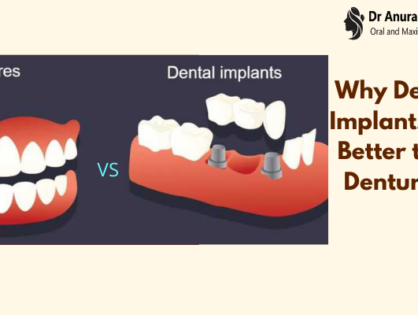
Dentures are removable prosthetic devices designed to replace missing teeth. They rest on your gums and can be taken out for cleaning.
There are different types of dentures:
- Complete dentures (for full mouth)
- Partial dentures (for some missing teeth)
- Flexible dentures
- Fixed dentures (implant-supported but still called dentures)
These are commonly known as denture teeth and have been used for decades.
What Is a Tooth Implant?
Let’s simplify this.
What is a tooth implant?
A dental implant is a titanium screw placed into your jawbone that acts like a natural tooth root. A crown or bridge is then attached on top.
In simple terms:
Tooth implant meaning = Artificial root + permanent tooth replacement
When multiple implants are used to replace all teeth, it’s called full mouth implants or permanent artificial teeth.
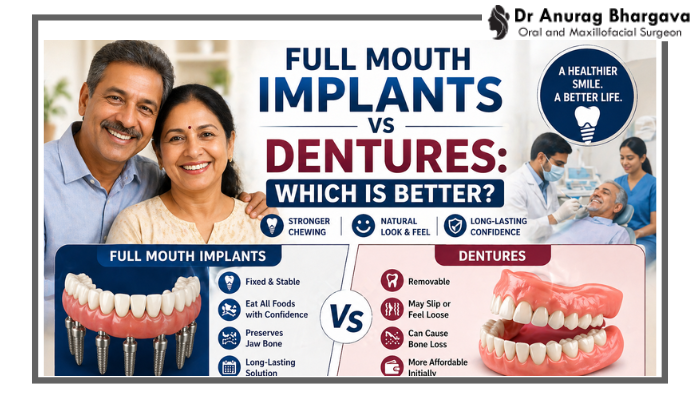
Full Mouth Implants vs Dentures: The Real Comparison
Now let’s get to the main question — which one is better?
1. Stability & Comfort
Dentures:
- Can feel loose over time
- May slip while eating or speaking
- Require adhesives sometimes
Implants:
- Fixed in the jawbone
- Feel like natural teeth
- No slipping or movement
Winner: Full mouth implants
If you’re tired of adjusting your denture teeth, implants feel far more natural.
2. Eating & Chewing Ability
Dentures:
- Limited chewing strength
- Avoid hard foods (nuts, apples)
Implants:
- Strong bite force
- Eat almost anything
Winner: Implants
With permanent dentures (implant-supported), you regain near-natural chewing ability.
3. Longevity
Dentures:
- Last 5–10 years
- Need replacement due to wear or gum changes
Implants:
- Can last 15–25 years or more
- Often lifetime with proper care
Winner: Implants
4. Jawbone Health
Here’s something many people don’t know.
Dentures:
- Do not stimulate bone
- Bone gradually shrinks
Implants:
- Act like real tooth roots
- Prevent bone loss
Winner: Implants
This is why implants are considered the best alternative to tooth implant solutions like dentures — they preserve your facial structure.
5. Appearance
Dentures:
- Can look good, but sometimes bulky
- May affect facial profile over time
Implants:
- Natural-looking
- Maintain facial structure
Winner: Implants
6. Maintenance
Dentures:
- Need to be removed and cleaned daily
- Require soaking
Implants:
- Brush like natural teeth
- No removal needed
Winner: Implants
7. Cost Factor
Now let’s talk honestly — cost matters.
Dentures:
- More affordable upfront
- Lower initial investment
Implants:
- Higher upfront cost
- Long-term value
Winner: Depends on budget
If you're looking for a budget-friendly option, denture teeth may suit you initially. But implants offer better long-term value.
Fixed Dentures: The Middle Ground
If you’re confused between both, there’s a hybrid option.
Fixed dentures (implant-supported dentures)
These:
- Are anchored on implants
- Do not slip
- Offer better stability than traditional dentures
They’re often called:
- Permanent dentures
- Permanent artificial teeth
This option balances cost and performance.
Who Should Choose Dentures?
You may consider dentures if:
- You’re looking for a low-cost solution
- You have medical conditions restricting surgery
- You prefer a non-invasive option
Dentures still work well for many patients — especially when properly fitted.
Who Should Choose Full Mouth Implants?
You’re a good candidate if:
- You want a long-term solution
- You want natural feel and function
- You have good bone density (or can undergo grafting)
- You’re tired of removable denture teeth
Emotional Reality: What Patients Actually Feel
Let’s talk real experiences.
Patients with dentures often say:
- “I feel conscious while eating in public”
- “They move when I talk”
Implant patients usually say:
- “It feels like my real teeth are back”
- “I don’t even think about it anymore”
That confidence difference is huge.
Are Implants Always the Best Option?
Not always.
Some cases require:
- Bone grafting
- Medical clearance
- Longer treatment time
So while implants are superior, they must be evaluated case by case.
Final Thoughts
So, Full Mouth Implants vs Dentures: Which Is Better?
If you want affordability → Dentures
If you want comfort, durability, and confidence → Implants
In today’s world, more people are shifting toward:
- Permanent dentures
- Permanent artificial teeth
- Implant-supported solutions
Because they don’t just replace teeth — they restore lifestyle.
Ready to Take the Next Step?
If you’re still confused between denture teeth and full mouth implants, the best decision comes from expert guidance tailored to your condition.
Book your consultation with Dr. Anurag Bhargava and find the most suitable, long-lasting solution for your smile.
Frequently Asked Questions (FAQs)
1. What are dentures?
Dentures are removable artificial teeth used to replace missing teeth. They rest on the gums and can be taken out for cleaning and maintenance.
2. What is a tooth implant?
A tooth implant is a titanium post placed in the jawbone that acts as a root, supporting a crown or bridge for permanent tooth replacement.
3. Are denture teeth comfortable?
Denture teeth can be comfortable initially, but may become loose over time and require adjustments or adhesives for better stability.
4. What are permanent dentures?
Permanent dentures are implant-supported dentures fixed in the mouth. They provide better stability and function compared to traditional removable dentures.
5. Are implants better than dentures?
Yes, implants are generally better in terms of stability, comfort, and longevity, but they come at a higher initial cost.
6. What are the types of dentures?
Types include complete dentures, partial dentures, flexible dentures, and fixed dentures supported by implants.
7. Can dentures damage gums?
Yes, ill-fitting dentures can cause irritation, sores, and bone loss over time if not properly maintained.
8. How long do dental implants last?
Dental implants can last 15–25 years or even a lifetime with proper care and regular dental check-ups.
9. Are implants painful?
Implant procedures are done under anesthesia, so pain is minimal. Mild discomfort after surgery is manageable with medication.
10. What is the best alternative to tooth implant?
Dentures are the most common alternative to tooth implant, especially for patients looking for a non-surgical and cost-effective solution.
About the Author
Dr. Anurag Bhargava is a qualified cosmetic and reconstructive surgeon specializing in facial deformity correction, rhinoplasty, jaw surgery, cleft lip and palate repair, and post-traumatic facial reconstruction. Dr. Bhargava is committed to delivering safe, evidence-based, and natural-looking results for patients of all ages.
BDS, MDS (Oral & Maxillofacial Surgery), FICOI (USA), Diplomate – WCOI (Japan)